What the X For You Algorithm Rewards
A practical read of the public X recommendation codebase, and what it implies for growing on X without treating the algorithm like a cheat code.
Most advice about growing on X sounds like it was written by someone trying to sell a posting calendar.
Post three times a day. Use hooks. Reply under big accounts. Pick a niche. Be consistent.
None of that is wrong, exactly. It is just too generic to be useful. The interesting question is not whether consistency matters. The interesting question is why some posts escape your follower graph while others die quietly in front of people who already know you.
The public xAI recommendation repository gives us a better mental model. I reviewed commit 9a4c220 from May 15, 2026, one day before this post was published. It is not a live production map, but it is enough to replace some folk wisdom with a more concrete view of the published system.
The short version: reach comes from entering the right candidate pools, surviving eligibility and safety filters, and scoring well for a specific viewer based on predicted actions.
That is a very different game from "get more likes."
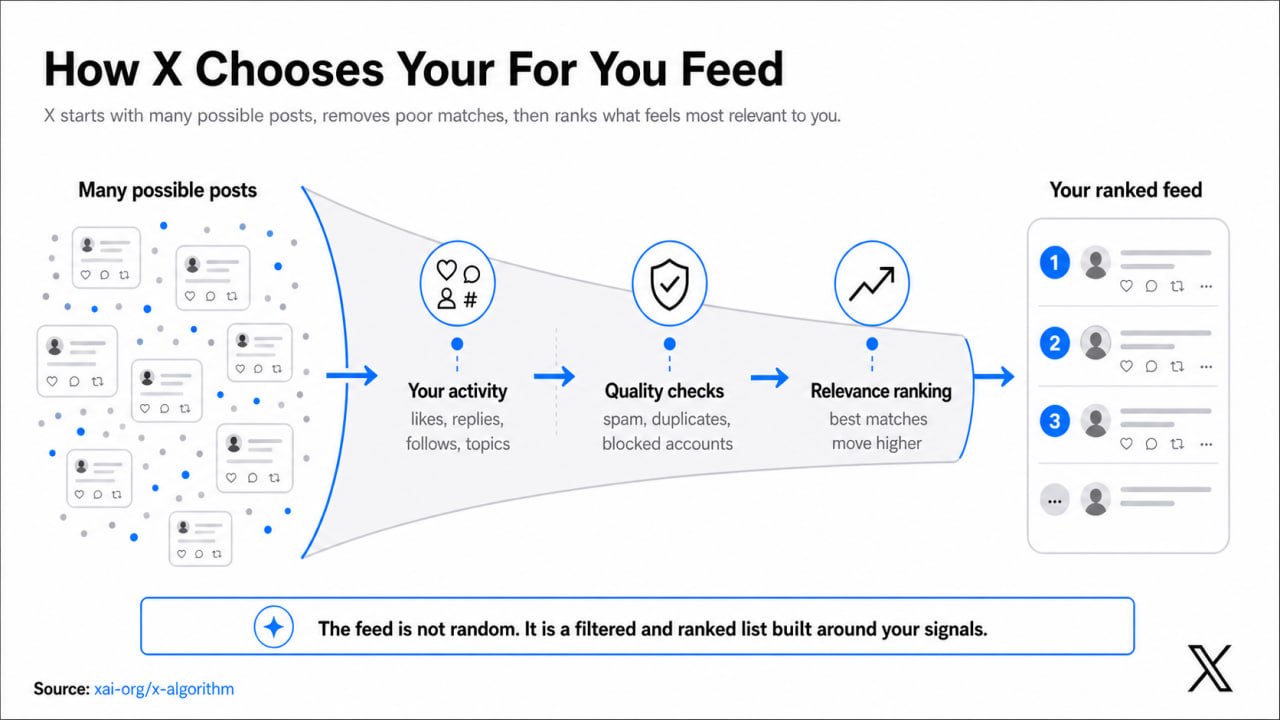
The feed is not one algorithm
The For You feed is better understood as a pipeline than a single ranking formula.
Before a post can be ranked, it has to be found. Organic posts can enter through in-network supply, global retrieval, topic retrieval, mixture-of-experts retrieval, cached posts, and other candidate sources. Then the system filters what is eligible, scores what remains, applies product constraints like diversity, and blends the feed with modules such as ads or recommendations.
This matters because creators usually obsess over the last step: ranking.
But ranking is useless if the post never enters the candidate set. A post that is not retrieved has no chance to win. The first job is not to trick the scorer. The first job is to become an obvious candidate for the right audience.
That sounds subtle, but it changes the strategy.
If you post one day about AI agents, the next day about fitness, the next day about politics, and the next day about startup fundraising, you may be interesting to a human. My inference is that this variety can make account positioning—and perhaps topic retrieval—less legible. The public code shows topic-aware retrieval; it does not prove that topical consistency causally improves distribution.
The best creators do not just have a niche. They create repeated signals around a few adjacent themes, formats, and audiences. That makes their posts easier to classify, retrieve, and test against people with matching histories.
Ranking is viewer-specific
The For You feed is not asking, "Is this a good post?"
It is asking something closer to, "Given this viewer's recent behavior, followed accounts, topics, and interaction history, what is this viewer likely to do with this post?"
That distinction is the entire game.
The public code points to retrieval and ranking systems that use viewer history to represent user interests, then compare candidate posts against that context. The same post can be a strong candidate for one person and irrelevant for another. Quality is not absolute. It is quality-for-a-viewer.
This is why I treat broad viral chasing as fragile. The code supports viewer-specific predictions and negative feedback; it does not reveal a durable account-level “poisoning” mechanism. A burst from an irrelevant audience may still fail to build durable distribution because those viewers are less likely to follow or engage with later work.
For growth, the better question is not "What will everyone like?"
It is: "What will the exact people I want more of reply to, save mentally, share, quote, click through from, and follow me after reading?"
That is less glamorous than viral bait. It is also more compounding.
The same logic applies from the viewer side. The For You feed learns from what people follow, open, ignore, mute, block, and repeatedly engage with. That means creators are competing inside a feedback loop shaped by both the post and the audience's prior behavior.
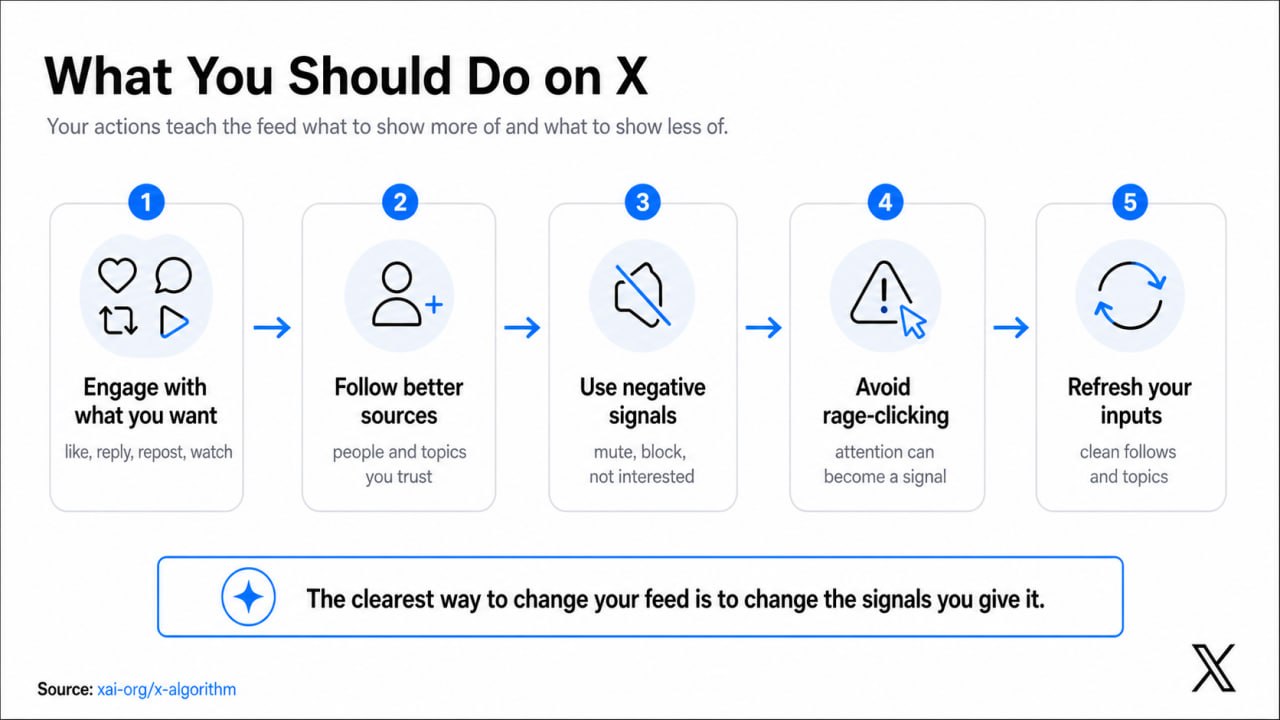
Likes are only one signal
One of the most useful things in the public snapshot is how many actions appear in scoring.
The system is not only predicting favorites. It can consider replies, reposts, photo expansion, clicks, profile clicks, video quality views, shares, DM shares, copy-link shares, dwell, quote behavior, quoted interactions, click dwell time, and follow-author probability. It also includes negative terms such as not interested, block, mute, report, and not dwelled.
The practical implication is obvious and often ignored: optimize for meaningful actions, not cheap applause.
A like is a low-friction nod. A reply asks more effort. A repost puts the post in front of someone else's audience. A DM or copy-link share moves it into another context. A profile click or follow can indicate interest beyond the single post. Those are interpretations of user behavior, not disclosed production weights; the repository exposes action predictions but not the deployed values needed to rank their relative importance.
That is why the strongest X content often looks like one of these:
- original analysis with a clear claim
- a useful framework people can reuse
- a chart, screenshot, or demo that makes something easier to understand
- a specific teardown of a product, market, or strategy
- a concrete lesson from building something
- a contrarian take with enough evidence to invite real disagreement
- a concise tutorial that saves someone time
My working hypothesis is that these formats are more capable of earning dwell, replies, shares, profile clicks, and follows than generic engagement bait. The code does not establish that causal effect; creators should test it against their own audience.
The weak version is engagement bait: vague hooks, outrage, fake vulnerability, "reply and I'll send it," or recycled wisdom with a dramatic first line. Some of that can still work in the short term. The problem is that the same system that rewards positive actions also watches negative ones. Blocks, mutes, reports, not-interested feedback, low dwell, and spam classification are not cosmetic. They are part of the distribution environment.
You can spike attention while earning negative feedback from the viewers who saw the post. Whether that persists as an account-level signal is not visible in the public snapshot.
Freshness matters, but flooding does not
The public pipeline includes age filters, seen IDs, impression history, served history, duplicate handling, retweet dedupe, and conversation dedupe. It also applies author diversity effects so one author does not dominate a ranked set.
That points to a simple operating principle: sequence ideas instead of flooding variants.
If you publish five near-identical takes in a short window, the public code suggests those posts may encounter per-feed duplicate and author-diversity constraints. Audience fatigue is a separate editorial risk; the repository does not quantify it.
Freshness helps. Repetition does not.
The better move is to turn one idea into a sequence of genuinely different artifacts:
- the core claim
- the data behind it
- the example that proves it
- the mistake people make
- the checklist for applying it
- the counterargument
That gives the system multiple clean objects to test, while giving humans multiple reasons to care.
Topic legibility is underrated
Creators talk about "niching down" like it is a branding exercise. In a recommendation system, it is also an information architecture problem.
Topic retrieval and topic filters need signals. Viewer-history models need patterns. New-user and topic-driven flows need to connect posts to people who have expressed or implied interest in related subjects.
If your account is about AI product strategy, say things that are unmistakably about AI product strategy. Use the vocabulary of the field. Name the objects. Show the work. Repeating the territory is positioning advice that is consistent with topic-aware retrieval, not a guarantee about ranking.
This does not mean every post should be identical. It means the account should have a recognizable center of gravity.
The best test is simple: if someone sees one strong post and clicks your profile, does the rest of the account make the follow decision obvious?
That is primarily a conversion question. The scorer predicts profile clicks and follow-author probability, but the inspected code does not show bio or pinned-post content entering ranking. Those surfaces matter after a viewer clicks through, not as demonstrated ranking inputs.
Safety and adjacency are part of growth
Growth advice usually treats safety systems as something only bad actors need to think about. That is naive.
The public snapshot includes visibility filtering, muted keywords, blocked and muted authors, topic mismatches, video eligibility, subscription eligibility, post safety, spam detection, and ads-related modules. The repository does not establish that ad adjacency changes organic ranking, so I treat organic eligibility, policy enforcement, and advertising placement as separate systems.
The practical recommendation is not "be bland." Bland content does not travel.
The recommendation is to avoid avoidable risk:
- do not rely on spammy calls to action
- do not stuff hashtags or keywords
- do not repost the same asset repeatedly
- do not farm outrage from people who are likely to mute or block you
- do not use misleading hooks that create quick exits
- do not attach risky media unless it is central to the point
- do not quote or reply into conversations where the surrounding context harms the post
Edgy content can create engagement. It can also create the exact negative feedback the ranking system is trying to avoid.
What I would actually do
If I were trying to grow an account from this mental model, I would not start with a content calendar. I would start with the audience I want the system to understand.
Pick three adjacent themes. For example: AI product strategy, agent workflows, and practical automation. Then publish posts that make those themes legible from multiple angles: analysis, examples, teardown, lessons learned, small artifacts, and opinionated replies.
Optimize each post for one meaningful action.
Some posts should earn replies because they make a specific claim. Some should earn reposts because they explain something cleanly. Some should earn bookmarks or copy-link shares because they contain a useful checklist. Some should earn profile clicks because they show taste and make people wonder what else you know.
Use media when it improves comprehension. A screenshot, chart, short demo, or visual breakdown can create dwell and make a post more trustworthy. But media should carry information, not decorate a weak take.
Reply with standalone value. Replies can be a discovery surface, but low-effort replies are a bad trade. A good reply should make sense even if someone sees it without the original post. Add evidence, an example, a sharper framing, or a useful disagreement.
Post when your core audience is likely to be active. Recent viewer actions appear in the published system, but the code does not reveal a specific “first test” or early-engagement seeding phase. Treat timing as a hypothesis and measure it.
And most importantly: make the follow promise clear. If one good post brings someone to your profile, the account should answer, in seconds, "Why should I see more from this person?"
What to avoid
The algorithmic view makes some common advice look actively harmful.
Do not chase every trending topic unless it serves the audience you want. That is positioning advice; the public code does not prove that trend-chasing weakens a persistent account signal.
Do not optimize only for likes. Likes are easy to count and easy to overvalue. A post that earns fewer likes but more shares, replies, profile clicks, and follows may be more valuable.
Do not flood the feed with near-duplicates. Fresh posts matter, but author diversity, duplicate filters, seen history, and served history all reduce the upside of brute force.
Do not confuse controversy with quality. A post that attracts blocks, mutes, reports, and not-interested feedback is teaching the system something too.
Do not hide the point behind vague suspense. The opener should carry the payoff, claim, or useful object quickly. Threads can work, but the first post has to earn the next click.
Do not make your account impossible to classify. Variety is good. Randomness is expensive.
The caveat that matters
This is not a guaranteed exploit.
The pinned public repository is a snapshot, not the full live production system. Production ranking is shaped by runtime values, flags, experiments, policy systems, market-specific behavior, and model versions we cannot see. The repository describes itself as mirroring the core system, but public evidence cannot establish current deployment fidelity.
So the right conclusion is not "here is the formula."
The right conclusion is more durable: clear account positioning can help humans understand the follow promise and may make posts easier for topic-aware retrieval to place. Posts—not accounts—remain the ranked candidates in the inspected pipeline.
Evidence key used in this post: “the code shows” refers to the pinned repository; “my inference” connects those mechanics to creator behavior; “I would” marks strategy to test rather than a ranking fact. The most relevant implementation is the published ranking scorer.
Fresh posts. Clear topics. Useful artifacts. Real engagement. Low negative feedback. A profile that makes the follow decision obvious.
That is not a hack. It is just what good distribution looks like when the feed is personalized, filtered, and scored by predicted viewer behavior.